Blog
How to improve sales performance across your revenue team
October 1, 2026
Read more

TL;DR: Sales intelligence turns scattered prospect and account data into insights reps can act on, from firmographics and intent signals to real-time trigger events. Teams that build this into their process consistently outperform those still running on instinct and manual research, but only when the underlying data is accurate, compliant, and delivered inside the tools reps already use.
Reps who rely on gut instinct and manual research spend hours a week digging through LinkedIn, company websites, and news alerts just to find the handful of facts that make an email or call land. That gap separates teams closing on instinct from teams closing on data, and it widens every time deal volume grows.
The stakes are real whether you are an account executive sharpening your email prospecting, or a manager looking for ways to lift sales team productivity across the floor. The question underneath both seats is the same: what does your team know about a prospect before the first message goes out, and how much of that is real signal instead of guesswork?
Sales intelligence is the practice of collecting, consolidating, and analyzing data from multiple sources to generate actionable insights that improve performance and revenue. Typically, this requires sales intelligence tools that equip sales leaders, managers, and reps with relevant information about the people and organizations they engage with.
It may sound complex, but the main objective of sales intelligence is to help sales teams gain a full picture of workflows, prospects, and the entire revenue cycle.
In short, sales intelligence helps teams work smarter, not harder. The sections below explore the specific advantages of sales intelligence compared to more manual ways of gathering prospect and customer details.
Sales intelligence helps teams identify and prioritize high-value opportunities, focusing their efforts where they are most likely to pay off. By leveraging sales intelligence, reps can spend less time on low-potential leads and more time nurturing relationships with accounts that are most likely to convert into significant deals.
Personalizing outreach at scale is difficult once you have hundreds or thousands of prospects to reach. Sales intelligence solves this by giving reps the decision-maker details, buying signals, and pain points they need to craft a relevant message quickly instead of researching each account by hand.
By aggregating data from multiple sources, sales intelligence paints a fuller picture of each prospect, going beyond basic firmographics to include technographic information, social activity, and buying intent signals. Teams use that picture to tailor their approach and propose the most relevant solution for each account.
Your total addressable market (TAM) is the total revenue or number of companies your product could realistically win. Sales intelligence uncovers TAM by analyzing your existing customers for shared patterns, so your team can build buyer personas and find more businesses that match them, leading to better-defined budgets and more accurate growth forecasts.
Sales intelligence monitors trigger events, such as leadership changes, funding announcements, and mergers, that signal a prospect is ready to buy, and alerts sellers the moment one appears so they can reach out with timing a generic pitch cannot match. Outreach's Deal Agent applies the same logic to existing deals, flagging risk before it derails a close.
Manual research eats into time reps could spend selling. Sales intelligence aggregates real-time signals, company news, social activity, and past interactions into one place, so reps stay current without digging through five different tabs. Reps using AI-assisted research reclaim 7 to 8 hours a week that would otherwise go to manual prospecting.
Sales strategies need continual refinement, which requires visibility into rep performance, process gaps, and which messaging is landing. A modern sales intelligence platform surfaces those insights directly, so leaders can see what is working, what is not, and where to experiment next.
Sales intelligence serves as a vital feedback loop for product teams, offering insights into customer needs and pain points. This information helps companies refine their offerings and stay ahead of the market.
Sales intelligence platforms can improve your sales forecasting. These tools analyze historical data, current pipeline information, and external market factors to generate more reliable projections. By considering variables like deal velocity and win rates, you can anticipate potential roadblocks or opportunities more precisely.
Facing aggressive growth targets with no extra reps, SailPoint turned to Outreach's Agents and Kaia™ to cut manual research and deliver more consistent, personalized outreach across every seller — now live in seven languages, with open rates running 50%+ above benchmark.
Sales intelligence isn't just for closers; it is a powerful asset for many roles across a sales organization. From frontline reps to strategic decision-makers, the insights these tools provide can transform how teams operate and drive results.
The best sales intelligence software gives sales managers a high-level view of their team's performance and pipeline health. They can use these insights to identify coaching opportunities, allocate resources more effectively, and make data-driven decisions to optimize sales strategies.
For sales development teams, sales intelligence is a goldmine for identifying and prioritizing high-potential leads. It helps them personalize outreach with relevant insights, increase response rates and set more qualified meetings for account executives.
Sales intelligence improves lead generation efforts by providing data to build highly targeted prospect lists. These tools help identify companies that match ideal customer profiles and show buying intent, enhancing lead quality.
Revenue operations teams use sales intelligence to streamline processes and enhance cross-functional alignment. They use these tools to identify sales-process bottlenecks, optimize territory planning, and ensure all revenue-generating teams work with consistent, high-quality data.
Sales intelligence follows a consistent cycle from raw data to a decision a rep can act on.
Sales intelligence platforms pull from public records and company filings, such as websites, press releases, SEC filings, patent registrations, and job postings, alongside proprietary databases built and verified by dedicated research teams rather than automated scraping alone.
Website visitor tracking reveals which companies are actively researching your product, third-party data partnerships add specialized data like technographics, and your own CRM and internal systems contribute historical deal data and support tickets. Poor CRM data hygiene is one of the most common reasons sales intelligence initiatives stall before they deliver value.
Raw data alone is not useful until it is verified and prioritized. The best platforms enrich and verify raw records, cross-reference sources to catch stale or inaccurate information, and then score leads and accounts by fit and buying intent so reps know where to focus first.
Real-time data allows sales teams to stay ahead of market changes, respond quickly to customer needs, and make informed decisions at every stage of the sales process. With instant access to the latest information about a company and its employees, delivered inside the tools reps already use, sellers can tailor their approach on the spot instead of digging through a separate research tab.
The output is only valuable if it changes what happens next. Reps use the surfaced insight to prioritize a call, personalize a message, or flag a deal at risk, while managers use the same signals rolled up across the team to spot coaching opportunities and pipeline health.
Effective sales intelligence combines multiple data categories to build detailed prospect profiles. Understanding these data types helps teams prioritize which insights matter most for their sales motion.
Firmographic data describes the structural characteristics of target companies. This includes industry classification, company size, employee count, annual revenue, geographic locations, and growth stage. Sales teams use firmographics to segment their total addressable market and match prospects with reps who specialize in specific territories or verticals.
Contact data identifies the individuals within target accounts who influence or make purchasing decisions. Key data points include names, job titles, department, direct phone numbers, email addresses, and social media profiles. Accurate contact data lets reps reach decision-makers directly instead of navigating gatekeepers.
According to research from Marketing Sherpa, B2B contact data decays by about 2.1 percent per month, or roughly 22.5 percent annually. This rapid decay makes real-time data verification essential for maintaining effective outreach.
Technographic data reveals the technology stack a prospect's company uses, from their CRM and marketing automation platforms to their cloud infrastructure and security tools. This intelligence helps reps understand current workflows, identify integration opportunities, and position their solution against existing tools.
For example, knowing a prospect uses a competitor's product allows reps to prepare relevant battle cards and competitive positioning.
Intent data tracks online behaviors that signal buying interest. This includes content consumption patterns, product research activities, competitor comparisons, and engagement with industry publications. Intent signals help teams identify actively in-market accounts, enabling reps to prioritize outreach to prospects showing genuine buying behavior.
Combined with AI-powered prospecting tools, intent data lets teams engage prospects at the right moment in their buying journey.
Trigger events are company changes that create sales opportunities. These include leadership changes, funding announcements, mergers and acquisitions, office expansions, new product launches, and regulatory shifts. Monitoring trigger events allows reps to reach out with timely, contextually relevant messaging.
For instance, when a prospect company announces a new funding round, sales teams can position their solution as essential for scaling operations during the growth phase.
Behavioral data tracks how individual prospects interact with your company across touchpoints. This encompasses website visits, content downloads, email engagement, webinar attendance, and social media interactions. Behavioral insights reveal which topics resonate with specific prospects and indicate where they are in the buying journey.
Identifying and targeting your ideal customer is vital to a strong sales process, a shorter sales cycle, and higher revenue. Sales intelligence helps you get the information you need quickly and at scale by analyzing key characteristics of your most successful customers, including industry verticals, company size, technology stack, and buying behaviors.
An ideal customer profile (ICP) is an in-depth summary of your company's perfect buyer, covering firmographics, technology stack, business challenges, decision-making process, and growth stage. Sales intelligence keeps that profile current. Instead of defining your ICP once and leaving it static, ongoing data analysis lets you validate and refine it as your company grows and markets shift.
Sales intelligence and sales enablement often get bundled into the same conversation, but they answer different questions. Confusing the two means buying a tool that gathers data when your team needs one that helps reps act on it, or the other way around.
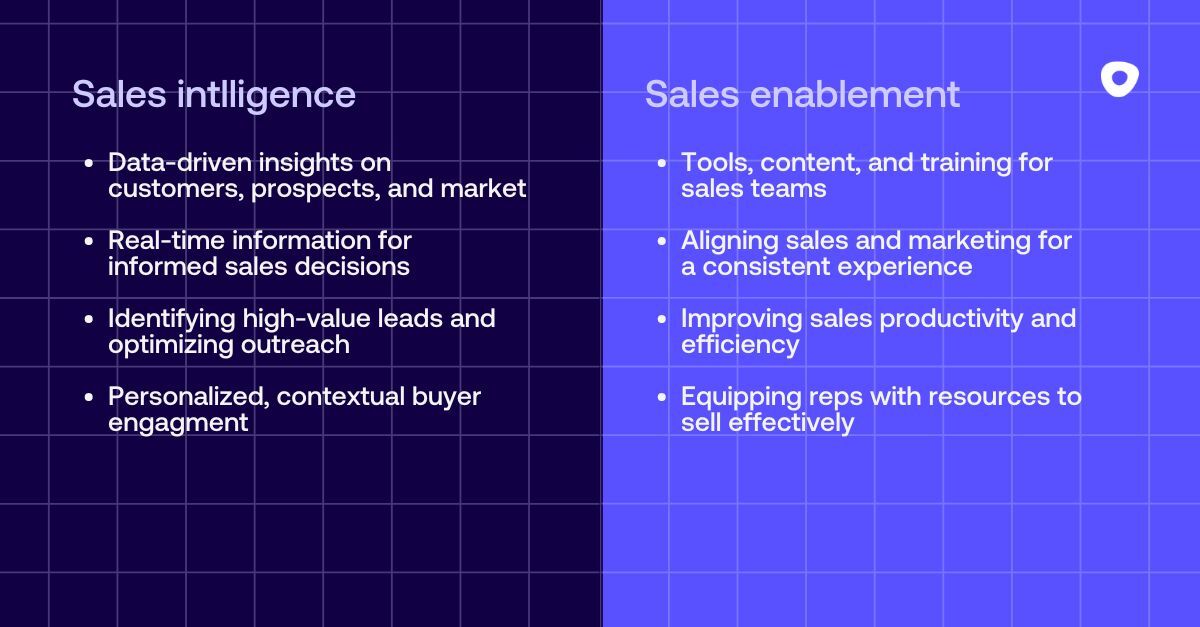
The two work best paired rather than chosen between. Feeding sales intelligence insights into your enablement content keeps pitch decks, battlecards, and talk tracks tied to what is happening in the market right now, instead of being built once and left to go stale.
A platform can be excellent at surfacing firmographic and intent data and still leave reps blind the moment a competitor enters the conversation. These are the specific capabilities worth checking if competitive insight is the job you need the platform to do.
A platform that only tags a competitor mention after the call cannot help the rep in that call, and by the time coaching happens, the deal has already moved on without the right response. Confirm detection happens live, during the conversation, not only in post-call analysis, since that is the difference between a rep who counters an objection in the room and one who reads about the missed opportunity a day later.
Walking into a call without knowing what the prospect already uses wastes the first several minutes on discovery that a good platform should have already answered, and a rep still guessing at the competitor rarely gets to real differentiation in time. When evaluating a platform, confirm its technographic coverage extends to the specific competitors you face most, not just broad categories like "uses a CRM."
A single blended win rate can hide that you are losing eight of every ten deals against one specific competitor while cleaning up against everyone else, and without that breakdown, leadership has no way to know where to invest in better battlecards, pricing flexibility, or rep training. Check whether the platform lets you filter results by named competitor, not just flag that a competitor was mentioned somewhere in the deal.
Standalone battle card libraries and static competitor spreadsheets go stale fast, and a rep mid-call will not stop to search a wiki for the right response. Platforms that surface competitive intelligence inside the call or email a rep already working in see far higher adoption, which matters because a capability nobody uses doesn't affect a single deal.
Outreach Conversation Intelligence reflects this shift, surfacing real-time battle cards based on what is said on a call, so reps get competitive context exactly when they need it instead of digging through a separate wiki mid-conversation.
See how Kaia joins calls, coaches reps in real time, and feeds what's actually said on a call into the same connected data powering Outreach's other AI agents — so every conversation makes the rest of your revenue workflow smarter.
Artificial intelligence has fundamentally changed what sales intelligence can deliver. Rather than simply aggregating data, AI-powered platforms now analyze patterns, predict outcomes, and recommend specific actions.
Traditional sales intelligence required reps to interpret raw data and decide how to act. AI shifts that burden to the platform. Machine learning algorithms process millions of signals to surface the insights that matter most, ranked by their likely impact on revenue.
According to Gartner research, by 2027, approximately 95 percent of seller research workflows will begin with AI, up from less than 20 percent in 2024. This shift reflects growing confidence in AI's ability to handle prospecting research and surface recommendations for reps to act on.
AI excels at identifying patterns that predict conversion likelihood. By analyzing historical wins and losses alongside prospect characteristics, AI models score leads more accurately than rules-based systems. This helps reps focus on accounts with the highest probability of closing.
Outreach's Revenue Agent automates research, identifies high-quality leads, and generates personalized outreach, transforming prospecting from a time-consuming chore into a streamlined workflow. In the Prospecting 2025 report, 100 percent of respondents reported saving time with AI, and 38 percent of reps specifically reported saving four to seven hours per week.
AI analyzes deal progression patterns to forecast outcomes and flag risks early. Rather than waiting for a deal to stall, AI-powered systems alert reps to warning signs and recommend corrective actions. This proactive guidance helps teams address problems before they derail opportunities.
AI-powered conversation intelligence analyzes sales calls and meetings to extract insights. These systems identify customer objections, competitive mentions, pricing discussions, and buying signals without requiring manual note-taking.
Beyond individual calls, conversation intelligence reveals patterns across your entire sales organization. Leaders can identify which talk tracks drive wins, where reps struggle with objections, and how top performers differentiate themselves.
Sales intelligence doesn't aim to replace human sellers with more data. AI handles repetitive research and data processing, freeing reps to focus on building relationships and solving customer problems, and the most successful organizations combine that capability with human judgment and empathy rather than choosing one over the other.
Outreach, the only agentic AI platform for revenue teams, helps every team member make smarter decisions, improve productivity, and achieve better outcomes across the entire customer lifecycle.
The intelligence capabilities above work best within a unified revenue platform. Watch how Outreach combines AI-powered prospecting, conversation intelligence, and predictive analytics to help teams identify high-value opportunities, personalize outreach at scale, and close deals faster.
Business intelligence (BI) encompasses a wide range of data analytics across an entire organization, providing insights for strategic decision-making at all levels. Sales intelligence zeroes in on data specifically relevant to the sales process. While BI offers a broad view, sales intelligence delivers targeted, actionable insights that directly impact a sales team's performance.
CRM platforms manage existing customer relationships by storing interaction history, tracking deal stages, and organizing account records. Sales teams use CRMs to log activities and monitor pipeline progress. Sales intelligence platforms serve a different purpose. They continuously collect and surface external data to help reps discover new opportunities.
While a CRM tracks what has already happened with known contacts, sales intelligence reveals what could happen next by monitoring buying signals, company changes, and market trends across accounts you may not have engaged with yet. The most effective sales organizations use both together, with sales intelligence feeding qualified prospects into the CRM where reps manage relationships through the sales cycle.
Sales intelligence data should be refreshed as close to real-time as possible. The ideal frequency depends on the data type. Contact information may require less frequent updates than rapidly changing intent data or technographic details.
While sales intelligence significantly enhances prospecting, it does not entirely replace traditional methods. Instead, it complements and improves existing approaches. For instance, sales intelligence can help prioritize cold calls by identifying high-intent prospects.
GDPR and similar regulations like CCPA have significant implications for sales intelligence. These laws govern how personal data is collected, stored, and used, emphasizing consent and the right to be forgotten. Reputable sales intelligence platforms have adapted by implementing strict data compliance measures, obtaining proper consent, providing transparency about data usage, and offering data deletion options.
Implementing a sales intelligence strategy can present several challenges, but proper planning can address them effectively. Common challenges include data quality and accuracy, integration with existing tools, adoption and training, and cost considerations.
Sales intelligence software is a category of tools that help sales teams gather, analyze, and apply data to improve sales processes and outcomes. These platforms automate the collection and processing of relevant information, providing sales professionals with actionable insights as they prospect and manage accounts.
Core capabilities include lead generation and enrichment, company profiling, intent data tracking, predictive analytics, CRM integration, competitive intelligence, real-time alerts, and territory mapping. Together, these features help teams identify high-potential prospects, personalize outreach, and improve overall sales efficiency.